




By STEVE CUFF
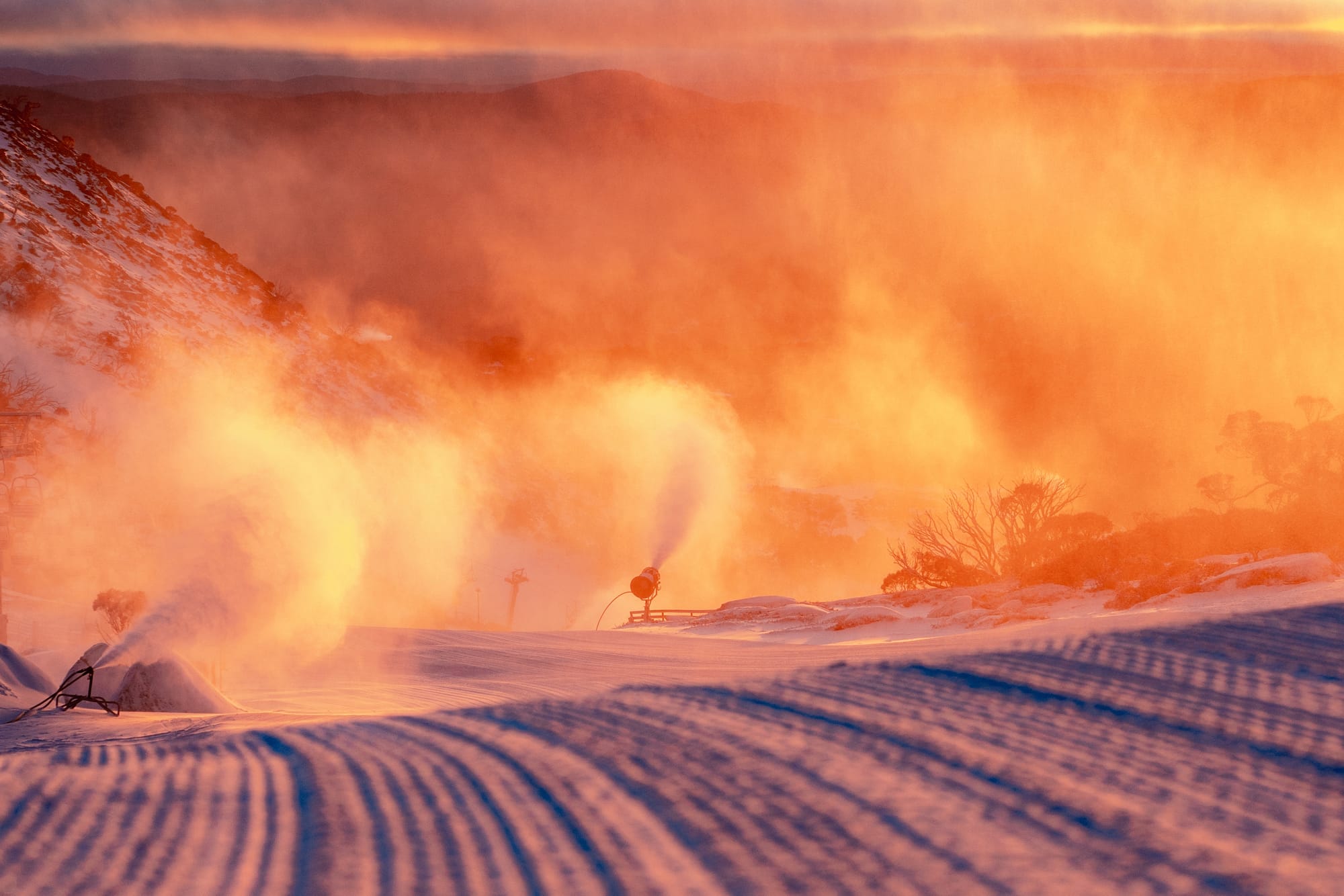
SNOWMAKING was the hot topic at the 2026 Snow Summit Conference in Thredbo in May, with industry veteran Peter Brulisauer labelling it significant to the snow industry’s future.
Brulisauer’s knowledge of snow is second to none; he was at the helm of Perisher and oversaw Vail Resorts’ Australian business. He is now Vice President, International Business Development for Alterra Mountain Company.
His personal insight as a keynote speaker at the event was stirring, highlighting the realities, challenges and opportunities ahead.
“There’s only one reality and set of associated challenges and opportunities that I think are worth discussing,” said Mr Brulisauer.
He presented a series of charts and information showing the effects of the poor 2024 snow season, which not only affected all resorts’ revenue but also impacted the wider region’s economy through reduced visitation. Skier days were down 370 thousand in 2024.
“When you attribute the greater value added, the cost to the economy of the bad season in 24 from the average is about $500 million. It’s a significant impact.”
He reflected on 2004, when then NSW Member for Monaro Steve Whan noted the impact of climate change on the Australian ski industry, particularly in NSW, would be devastating for the economy and for local regions. “The alpine resorts in the Monaro electorate are the key economic drivers of the region,” said Mr Whan in 2004.
Brulisauer said, as of 2025, Australia is tracking toward a high-impact zone identified in the 2008 CSIRO report outlining the effects of climate change on snow conditions. That report examined past climate trends (1957-2002) at four alpine sites in southeastern Australia, projected future snow conditions for 2020 and 2050, and assessed the level of snowmaking required to adapt to those projected changes.
In recent years, the NSW Government has invested about $50 million in the Snowy Mountains, and the Victorian government $32 million in hiking and mountain biking for summer-season growth. Brulisauer questioned that investment.
“Is investing in walking / MTB trails the most effective way for Government to minimise the impacts of climate change on regional mountain economies and jobs? Are these trail investments benefitting the local tourism economy as forecast?”
OVERSEAS COMPARISON
The 2026 season in the Northern Hemisphere saw record visitation, despite unfavourable snow conditions in certain areas. Globally, there are 399 million skier visits.
Comparing Australia and the world’s snow resorts, he noted Australia’s snow visitation is not growing, even though our population is. We have not passed pre-covid 5-year average visitation numbers.
Snowmaking is more prominent in most overseas resorts. Italian resorts have 90 per cent of their groomed trails covered in snowmaking, Austria 75 per cent and Switzerland 53 per cent. Citing an industry report, resorts covered with more modern snowmaking were able to continue providing a similar level of skier visits and economic resilience.
Australian resorts describe their snowmaking as a percentage of their skiable terrain, which is not ideal for comparison against the European percentage of groomed trails.
Alois Schopf, one of Austria’s longest-serving columnists, said, “This winter in South Tyrol was surprisingly good for ski tourism: little snow, but plenty of sunshine, pleasant temperatures, and perfect slopes thanks to artificial snowmaking. The 2025/26 season will likely go down as one of the most successful ski seasons in Austrian tourism history.”
Snowmaking has become essential, indispensable and impossible to imagine skiing without it.
“It’s the difference between open and closed,” said Mr Brulisauer.
Snowmaking is publicly funded or co-funded in many countries around the world. It’s recognised as being core public infrastructure, enabling climate resilience and regional development.
In 2024, Italy’s Ministry of Tourism allocated 230 million Euros to support cable car renovation, modernisation and artificial snowmaking systems. France, Switzerland, and China provide government assistance to the snow industry.
Brulisauer stated that despite investments in snowmaking automation, water cooling, gun and pipe replacement, and all-weather snowmaking, the area covered by snowmaking at most major Australian resorts has not increased significantly over the last 10-15 years.
Snowmaking equipment is state-of-the-art. However, the entire project of purchasing and installing the equipment, with kilometres of piping, is very expensive.
For Australian resorts to keep up with and adapt to the low and high impact climate change scenarios in the 2008 CSIRO report, they need further substantial investment. But should resorts be responsible for the wider region’s economy?
Peter Brulisauer said, “Given the generally strong ROI from snowmaking investments, but lack of major expansion in recent years, do the Australian resorts need government help to make investments in snowmaking to minimise the effects of climate change to protect regional economies, jobs and communities and the sport? Would that be appropriate?”


